

HOME CHARGING • POWER PLANNING
Manage the Charge.
Respect the Home.
Understand what EV charger load management can change—and what still requires an electrical assessment.
DISCUSS YOUR INSTALLATION →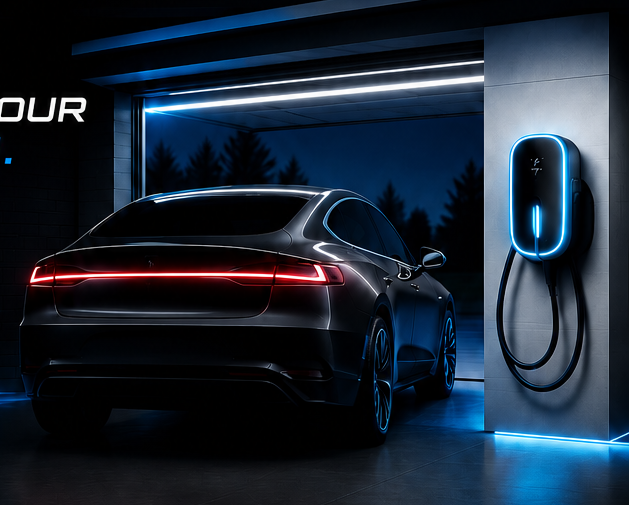
EV charger load management can be part of a home-charging design when electrical capacity is limited or several charging units share available power. For Dallas EV charger installation planning, begin with the service equipment, panel, proposed charger and driving schedule. Software features do not replace that physical review.
What EV charger load management means
Load management is a broad term. In a supported system, the charging rate may be limited, divided or adjusted according to defined electrical conditions. The equipment, sensors, communication path and commissioning method depend on the manufacturer and design.
Tesla describes Dynamic Power Management as a Wall Connector feature that adjusts the charging rate in real time based on available power in the electrical panel. Tesla lists approved hardware and commissioning requirements for that function. Other manufacturers may use different products, limits and terminology.
Separate dynamic control from a fixed setting
A charger can also be commissioned at a fixed maximum output that is below its advertised maximum. That is not necessarily the same as a dynamic system responding to changing household loads. Ask the proposal to say which method is being used and what equipment makes it work.
Do not increase an installer-controlled output value because charging seems slow. The approved setting is tied to the electrical design. If charging performance does not meet the agreed plan, have the responsible installer review the vehicle, charger, circuit and configuration together.
Questions for the proposed system
- Is the plan fixed-output, group sharing or dynamic power management?
- Which exact charging units and monitoring hardware are supported?
- What happens if communication or a sensor fails?
- Who commissions the system and documents the final settings?
- How will a future charger or major appliance affect the design?
Load management does not prove spare capacity
A product feature is not an electrical load calculation and does not establish that every home can accept the same installation. The electrician still needs the relevant equipment ratings, existing loads, proposed route and local requirements. A panel photograph can help start the conversation, but it does not finish the assessment.
The U.S. Department of Energy notes that residential charging equipment and charging time vary with the vehicle, charger power and electrical service. Use that principle when setting expectations. A managed system can only operate within the limits of the approved installation and the vehicle’s own charging capability.
Plan the owner handover
Ask the installer to demonstrate normal charging, expected reduced-rate behavior and any visible status that indicates a problem. Keep the commissioning record, model numbers and manufacturer instructions. If an internet connection supports monitoring or updates, clarify what charging behavior remains available during a network outage.
Also decide who may change owner-level schedules and access controls. Keep household settings separate from professional electrical configuration. A clear handover helps prevent a future account change or app update from being mistaken for permission to alter electrical limits.
Frequently asked questions
Can load management avoid every service upgrade?
No. It may be one design option for some properties, but the equipment, available capacity and complete project still require assessment.
Will my vehicle always charge at the charger’s maximum?
No. The vehicle, charger, configured output and any active management can all affect the rate.
Can two chargers share power?
Some supported systems provide group power management. Confirm the exact charger models, number of units and manufacturer rules before assuming compatibility.
What happens if home demand rises while the car is charging?
A properly designed dynamic system may reduce charging according to its supported logic. Ask the installer to explain the expected behavior for the selected product.
Can I install the monitoring equipment myself?
Do not work inside electrical equipment. The installation and commissioning must follow manufacturer instructions and applicable local requirements.
PRIMARY SOURCES REVIEWED OCTOBER 1, 2026
Tesla Wall Connector Power Management · U.S. Department of Energy charging equipment overview
LET’S REVIEW THE WHOLE SYSTEM
Your panel. Your charger. A documented plan.
Send your vehicle, charger model and safely taken photos of accessible equipment labels. EV Garage Install will discuss the next assessment step.
CALL 972-333-5448 TEXT PROJECT PHOTOS