

PLUG-IN HYBRIDS • HOME CHARGING
PLUG-IN HYBRID HOME CHARGING: MATCH THE SETUP TO THE VEHICLE
A plug-in hybrid may need less energy per night than a battery-electric vehicle, but its charging circuit still deserves a vehicle-specific, code-aware plan.
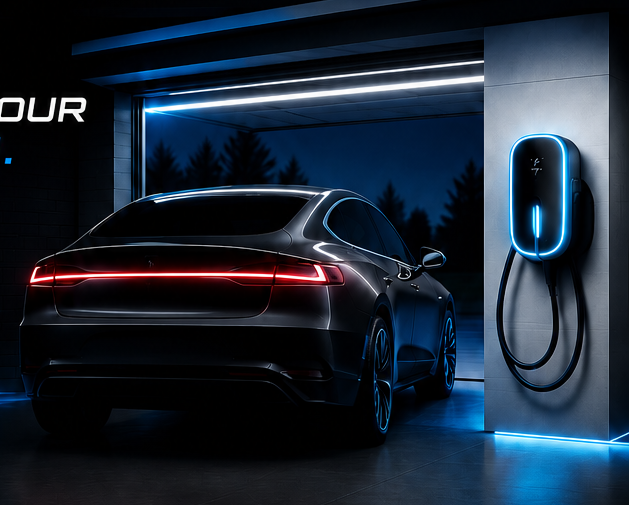
Plug-in hybrid electric vehicles combine an internal-combustion engine with a battery that can be charged from an external source. Their smaller batteries can make home charging needs look simple, yet the best setup still depends on the exact vehicle, its onboard charger, the daily trip and the home’s electrical service.
Begin with the actual vehicle
Find the model year, charge-port type, portable-cord rating and maximum AC charging rate in the owner documentation. Do not select equipment from the connector alone. The vehicle’s onboard charger can limit power even when the station and circuit are rated higher.
The U.S. Department of Energy explains that charging time changes with battery capacity, onboard-charger capability, equipment output and state of charge. For a plug-in hybrid, the practical question is often whether the usual electric miles can be restored during the hours the car is parked.
Compare Level 1 and Level 2 using the routine
Level 1 uses a 120-volt connection and can be sufficient for some plug-in hybrid schedules. Level 2 uses a 240-volt circuit and can provide faster charging when the vehicle accepts it. Faster is not automatically better: installation scope, available capacity, future vehicles and departure time all matter.
- Record the daily distance: Separate the ordinary commute from occasional long trips.
- Record the parking window: Note when the vehicle normally arrives and leaves.
- Check future plans: A later battery-electric vehicle may change the value of circuit capacity or conduit planning.
- Check the electrical service: Existing major loads must be considered before a new continuous load is added.
Keep the gasoline engine out of the electrical assumptions
The presence of an engine does not reduce the need for correctly installed charging equipment. A receptacle or hardwired station must follow the product instructions and the requirements adopted by the local authority having jurisdiction. Permit and inspection rules are local; they should be confirmed for the property rather than inferred from a model code or another city.
Make the garage layout usable
Place charging equipment so the connector reaches the inlet in the normal parking position without crossing a doorway or lying in a tire path. If two cars share the garage, test both parking arrangements. Protect the cable from door tracks, stored items and sharp bends. Outdoor or exposed locations require equipment and installation methods suitable for that environment.
What to send with a quote request
Useful photos show the electrical panel label and breaker area, the wall from panel to parking space, the proposed charger location and the vehicle in its normal position. Include the vehicle details and equipment cut sheet. Photos support planning but do not replace an on-site electrical evaluation.
FAQ
Does every plug-in hybrid need Level 2 charging?
No. The answer depends on battery size, vehicle charging limits, daily electric miles and parking time. Level 1 can meet some routines; Level 2 can provide additional recovery time and future flexibility.
Will a larger station make the car charge at its advertised maximum?
Only up to the limits of the circuit, station and vehicle. The lowest applicable limit controls actual AC charging power.
Can a future EV use the same installation?
Possibly, but connector standards, equipment ratings, circuit capacity and vehicle requirements must be checked. Future readiness should be planned, not assumed.
Is a new plug-in hybrid charger a do-it-yourself circuit?
No. New branch circuits and charging equipment should be evaluated and installed by qualified professionals under applicable requirements. Avoid hazardous work inside panels or energized equipment.
SOURCES CHECKED OCTOBER 4, 2026
U.S. Department of Energy: Plug-In Hybrid Electric Vehicles · U.S. Department of Energy: Home Charging · ENERGY STAR: EV Chargers
PLAN A SAFER HOME-CHARGING SETUP
Talk through the vehicle, parking position and electrical service before equipment is selected.
EV Garage Install can review the installation scope and prepare a practical quote for a code-compliant home charging circuit.