

CONNECTOR PLANNING • HOME CHARGING
J3400 AND J1772 HOME CHARGING: PLAN THE CONNECTOR TRANSITION
A familiar plug shape does not answer every compatibility question. Match the vehicle inlet, approved adapters, charger cable, circuit and future vehicle plan.
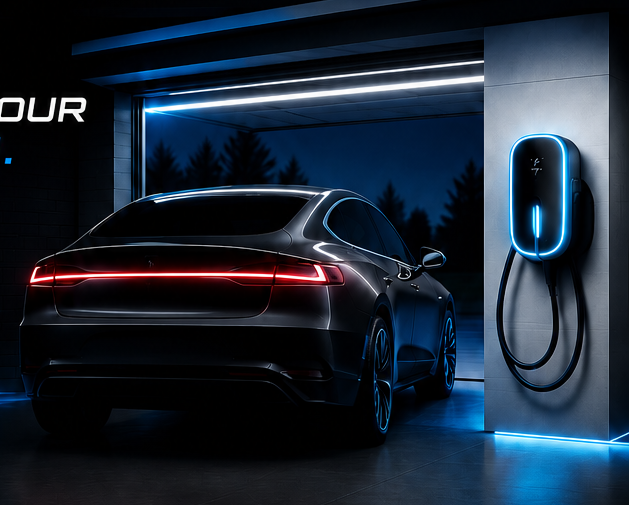
The North American charging landscape is changing, and labels such as J3400, NACS and J1772 can make a home-charging decision sound more complicated than it needs to be. Begin with the vehicle you actually own, the charging equipment it supports and the electrical capacity available at the property. Connector planning should not replace a proper circuit and load assessment.
Review the home charging installation services and installation process while comparing equipment options. The final plan should treat the connector, circuit and parking layout as one system.
Start with the vehicle inlet and charging manual
Confirm the connector on the vehicle, its maximum AC charging rate and any adapter guidance in the current owner documentation. A connector can physically fit while the vehicle, charger or adapter imposes another limit. The U.S. Department of Energy explains that charging speed depends on the vehicle, charging equipment and electrical supply; the lowest supported rate in that chain controls the session.
Understand the two connector paths
J1772 has long been common for AC charging on many non-Tesla vehicles. The J3400 connector, based on the design often called NACS, is being adopted by additional automakers and charging providers. Model year, trim, production date and market can affect what a particular vehicle uses. Verify the exact vehicle instead of relying on a brand-wide assumption.
Plan around real vehicles, not a logo.
Send the year, make, model and charging-port photo for every vehicle that may use the station. Include manufacturer-approved adapter information if an adapter is part of the plan.
Use only approved adapters and combinations
An adapter is part of the current path, so it must be approved for the vehicle and charging equipment. Check the vehicle maker and charger maker instructions. Do not stack adapters, alter a connector or use an improvised cord. Stop using any component that is damaged, unusually hot, loose or discolored.
Keep the electrical design separate from the plug decision
The branch circuit, overcurrent protection, wiring method, equipment rating and installation instructions still determine the electrical scope. Choosing J3400 rather than J1772 does not automatically change the home’s service capacity. A qualified electrician should evaluate the proposed equipment and locally adopted requirements before installation.
Plan for a second or replacement vehicle
If another vehicle may arrive soon, list both vehicles and their parking positions. A dual-connector product, manufacturer-approved adapter strategy or later equipment change may be considered, but each option has limits. Ask how cable reach, connector storage, access control and load management would work for the household rather than choosing on connector shape alone.
Questions to answer before ordering
- Which AC connector does each exact vehicle use?
- Does the manufacturer authorize the proposed adapter?
- What charging current can the vehicle accept?
- Where will the cable and connector rest when not in use?
- Could a future vehicle change the preferred equipment?
FAQ
Is J3400 the same as every product called NACS?
Do not assume identical capabilities from a marketing label. Check the published standard reference, product listing, manufacturer instructions and exact vehicle support.
Will a J1772 charger become useless?
Not necessarily. Many vehicles use J1772 directly, and some manufacturers support specific adapters. Confirm the combination for each vehicle.
Does an adapter increase charging speed?
No. Charging remains limited by the electrical supply, charger, adapter and vehicle. An adapter cannot add capacity that the rest of the system does not provide.
Should the connector choice come before the site assessment?
Share your preferred equipment, but let the vehicle requirements, parking layout and electrical assessment inform the final selection.
SOURCES CHECKED OCTOBER 5, 2026
U.S. Department of Energy: Charging Infrastructure · U.S. Department of Energy: Home Charging · ENERGY STAR: EV Chargers
PLAN THE COMPLETE INSTALLATION
Match the vehicle, equipment and electrical system.
Send the vehicle details, proposed charging location and safely taken photos of accessible electrical labels. EV Garage Install can discuss the installation scope and prepare a practical quote.