

North Texas home EV charging guide
BUYING A USED CHARGER?
VERIFY BEFORE YOU INSTALL
A low purchase price is not useful if the unit lacks the right rating, history, support or safety documentation.
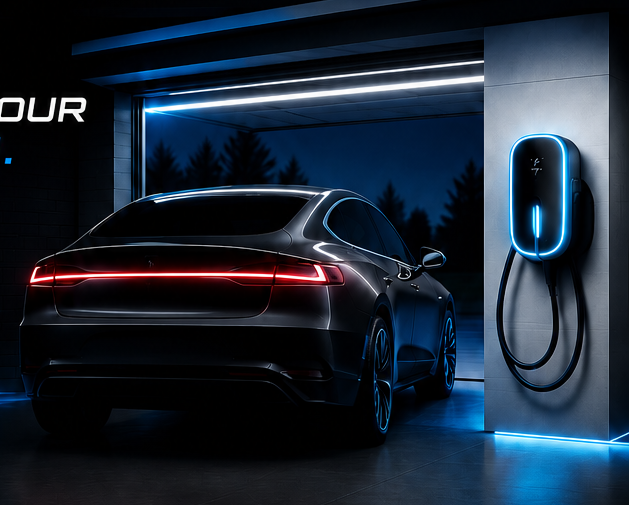
Used charging equipment can appear attractive, especially when a seller is changing vehicles or moving. The label, condition and history matter more than the listing headline. Before installation, confirm that the exact unit is appropriate for the vehicle, location and planned circuit.
Identify the exact equipment
Request clear photographs of the model label, serial number, input and output ratings, connector, cord and plug if equipped. Compare that information with the manufacturer’s official documentation. Similar-looking units can have different current ratings or installation requirements.
Do not rely on a seller’s claim that a charger is “universal.” Compatibility includes connector format, vehicle behavior, electrical supply and any adapter requirements approved by the relevant manufacturers.
Confirm a recognized certification mark
Look for a genuine listing or certification mark from an organization recognized through OSHA’s NRTL program, then verify the certifier and product information when possible. A decorative “tested” icon or generic compliance language is not the same as a recognized certification mark.
A missing, altered or unreadable label makes it difficult to establish the unit’s ratings and installation instructions. That uncertainty should be treated as a material defect, not a cosmetic issue.
Check recalls and manufacturer support
Search the exact model and serial range in the CPSC recall database and on the manufacturer’s support site. Confirm whether the manufacturer still provides the manual, firmware, replacement cable or warranty-transfer information.
If a recall applies, follow the official remedy. Do not install the unit based on a seller’s promise that an unspecified repair was completed.
Ask about use, removal and storage
Request the reason for removal and whether a licensed professional disconnected a hardwired unit. Ask about water exposure, impact, overheating, fault codes, modified plugs, cable repairs and storage conditions. Treat gaps in the history as unknowns.
Visible cleanliness does not prove internal condition. Cracked insulation, bent pins, discoloration, loose strain relief or a damaged enclosure are reasons to reject the equipment or seek manufacturer guidance.
Have the installation designed for the actual unit
A used charger still needs a site-specific circuit and mounting plan. The professional evaluating the installation should have the manual and label information before confirming the scope.
Do not assume an existing receptacle or breaker is appropriate simply because the plug appears to fit. The circuit, receptacle, conductor, grounding and protection must be evaluated together.
Frequently asked questions
Is a used EV charger automatically unsafe?
No, but its model, certification, condition, history, recall status and installation requirements must be verified.
Does the original warranty transfer?
Policies differ. Check the manufacturer’s current warranty terms using the exact model and purchase history.
Can an electrician certify a damaged charger?
An electrician can evaluate the installation and visible condition, but manufacturer or qualified product-service guidance may be needed for internal equipment defects.
What if the label is missing?
Without ratings and model identification, safe matching and recall research may not be possible. Replacement is usually the clearer path.
Can I reuse a plug-in unit on any matching outlet?
No. Plug shape alone does not establish that the circuit, receptacle condition, rating and installation are suitable for continuous EV charging.
Official safety references
For general charging safety, review the U.S. Fire Administration electric vehicle fire safety guidance. For product certification context, see the OSHA Nationally Recognized Testing Laboratory program. Product recall information is available through the U.S. Consumer Product Safety Commission recall database.
Get a site-specific EV charging plan
Every garage, circuit route, electrical service and charger model is different. EV Garage Install can evaluate the installation conditions and build a clear scope for your home.