

MULTIFAMILY CHARGING • PROJECT PLANNING
Shared property.
Clear charging responsibility.
Condo and townhome charging begins with parking rights, electrical ownership, approvals, metering and a maintainable route.
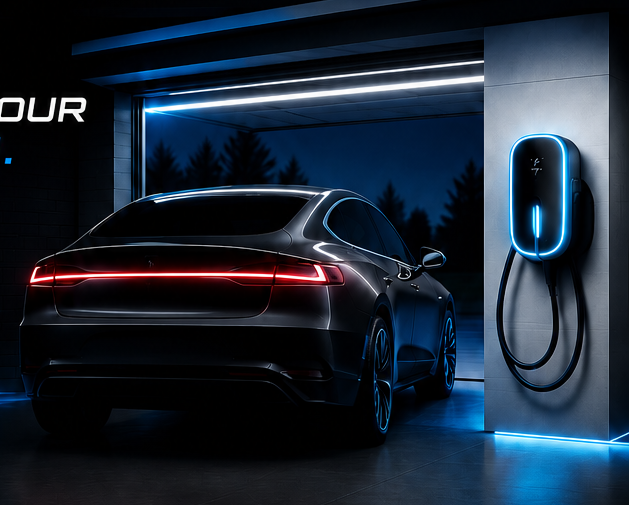
Condo and townhome EV charging adds property and management questions to the electrical design. A resident may control a parking space without controlling the walls, conduit route, electrical room or meter that a charger would use. Those responsibilities should be settled before equipment is purchased.
Start with the parking space and property documents
Confirm whether the space is deeded, assigned, leased, shared or part of a common area. Identify who owns the wall or post, who controls the proposed wiring route and who can approve construction. Ask the association or property manager for the current architectural request process and any existing charging policy.
Do not rely on a neighbor’s installation as proof that the same route or equipment is allowed. Buildings, parking rights, electrical capacity and governing documents can differ within one development.
Get the route approved before buying the charger.
A product choice cannot solve an unapproved path through common walls, ceilings, landscaping or electrical rooms.
Identify whose electrical system supplies the charger
A charger may be supplied from an individual dwelling panel, a house meter, a dedicated meter or a managed shared system. Each option changes routing, capacity, billing and maintenance. The project team should document the power source and the party responsible for electricity use.
The U.S. Department of Energy’s Alternative Fuels Data Center identifies parking, electrical-service access, billing and legal concerns as key multifamily charging considerations. Its guidance treats multifamily installation as a coordinated property project rather than a single appliance purchase.
Choose individual or shared charging intentionally
An individual station may offer simple day-to-day access when the parking space and power route support it. Shared stations can serve more residents but need rules for access, session length, payment, guest use and vehicles that remain after charging ends.
Networked equipment may support access control and energy reporting, but subscription, connectivity and data responsibilities should be understood before selection. Ask who owns the account, who receives alerts and what happens if the resident moves.
Plan capacity for more than the first request
A building may support one charger without having an efficient plan for ten. The association should consider future demand, panel and service capacity, raceway pathways and whether load management is appropriate. The first installation can either preserve or complicate later options.
EV Garage Install’s load-management guide explains common capacity concepts, while the installation quote guide lists useful photos and project information.
Put ownership and restoration in writing
The proposal and approval should identify who pays for design, permits, installation, electricity, software, repairs, removal and surface restoration. Insurance or contractor-document requirements may come from the property’s governing process. Verify them with the responsible association or manager for the actual project.
Local permit and inspection requirements depend on the jurisdiction and scope. Association approval does not replace municipal approval, and municipal approval does not grant permission to alter common property.
Condo and townhome EV charging questions
Should I buy the charger before association approval?
Usually the safer sequence is to define the route, power source and approval conditions first, then select compatible equipment.
Can my dwelling panel supply a remote parking space?
Possibly, but distance, route ownership, capacity and applicable requirements need project-specific assessment.
Who pays for electricity at a shared station?
The property should define the billing method, account owner and administration before installation.
What happens when I sell or move?
Ownership, removal rights, account transfer and restoration responsibility should be documented in advance.
Can one approval cover future stations?
Only if the property deliberately adopts a broader plan. A one-space approval should not be assumed to authorize later work.
Use the EV charging services overview and installation process to prepare for the property and electrical assessment.
PRIMARY SOURCES CHECKED OCTOBER 2, 2026
U.S. DOE Alternative Fuels Data Center — Multifamily Housing Charging · U.S. DOE Alternative Fuels Data Center — Infrastructure Development
LET’S PLAN YOUR INSTALLATION
Your garage. Your vehicle. A clear plan.
Send your address, vehicle details and safely taken photos of the parking area and accessible electrical equipment labels. Do not remove electrical covers for photos.