


CABLE REACH • GARAGE SAFETY
EV CHARGER CABLE MANAGEMENT: PLAN REACH WITHOUT CREATING FLOOR HAZARDS
The charger location is only useful if the cable reaches the parked vehicle without crossing a walkway, being driven over or getting pinched by a door.
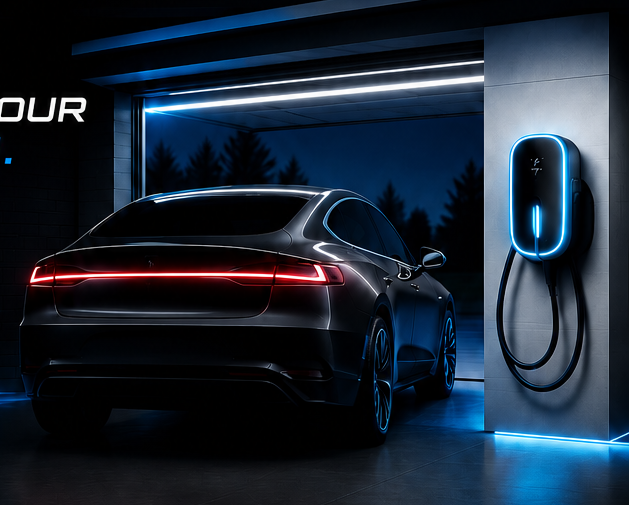
Cable management is part of charger-location planning, not an accessory decision after installation. A wall unit can be electrically correct and still be awkward if the cable lies across a doorway, rests under a tire or barely reaches the vehicle inlet. Measure the daily parking position and design storage before mounting equipment.
Map the vehicle in its normal position
Park as it will be used every day and locate the charge port. Open doors, the liftgate and the garage door. Note shelving, steps, bollards and the path people use to enter the house. If more than one vehicle may use the station, repeat the check for each parking orientation.
Use the actual cable length and manufacturer limits
Check the product data for cable length, connector holster, mounting orientation and permitted accessories. Do not add a household extension cord or an unapproved cable extension. The charger and vehicle manufacturer must expressly support any adapter or accessory.
Keep the cable out of predictable damage paths
- Avoid garage-door tracks, hinges and closing edges.
- Do not route the cable under a vehicle or across a tire path.
- Keep it away from sharp shelving and hot equipment.
- Prevent loops from lying across steps or walkways.
- Store the connector where it will not strike the floor.
Choose storage that matches the equipment
A manufacturer-approved holster or cable organizer can keep the connector clean and the floor clear. Allow a broad, natural coil rather than tight bends that strain the cable. Do not hang the cable from the connector head or modify the enclosure to add a hook.
Plan for outdoor exposure
Outdoor equipment needs the appropriate rating, and cable storage should keep the connector protected as the manufacturer directs. Consider vehicle position during rain, irrigation coverage, snow or debris, and public walkway exposure. Do not create a route across a sidewalk or shared path.
Coordinate cable reach with electrical design
The preferred wall location must also work with the electrical-panel route, structural mounting surface, required clearances and local rules. A longer electrical run or a different charger location may change the installation scope. The contractor should balance access with electrical and code requirements.
Check the setup after commissioning
Plug in and unplug from the normal stance. Confirm the cable is not under tension, the connector latches normally and the vehicle can leave without snagging the cord. Record the storage method for other household drivers.
FAQ
Can the charging cable touch the floor?
Follow the manufacturer’s instructions. The goal is to avoid damage, standing water, contamination and trip or tire hazards.
Can I install a ceiling reel?
Only if the charger manufacturer permits the specific accessory and installation. Do not add a device that strains, twists or alters the listed cable assembly.
Should the charger be centered between two spaces?
Not automatically. Measure both vehicles, port locations and parking positions, then consider circuit routing and required clearances.
What if the cable is suddenly harder to connect?
Stop and inspect for visible damage or contamination without opening equipment. Follow manufacturer guidance and seek service if fit, latching or fault behavior has changed.
SOURCES CHECKED OCTOBER 5, 2026
U.S. Department of Energy: Home Charging · U.S. Department of Energy: Charging Equipment · Tesla: Wall Connector Support
PLAN A SAFER HOME-CHARGING SETUP
Talk through the vehicle, parking position and electrical service before equipment is selected.
EV Garage Install can review the installation scope and prepare a practical quote for a code-compliant home charging circuit.