


POWER OUTAGE • HOME CHARGING
HOME EV CHARGER AFTER A POWER OUTAGE: SAFE RESTART QUESTIONS
A restored utility does not mean every charging problem should be reset away. Start with visible conditions, manufacturer guidance and a useful record of any fault.
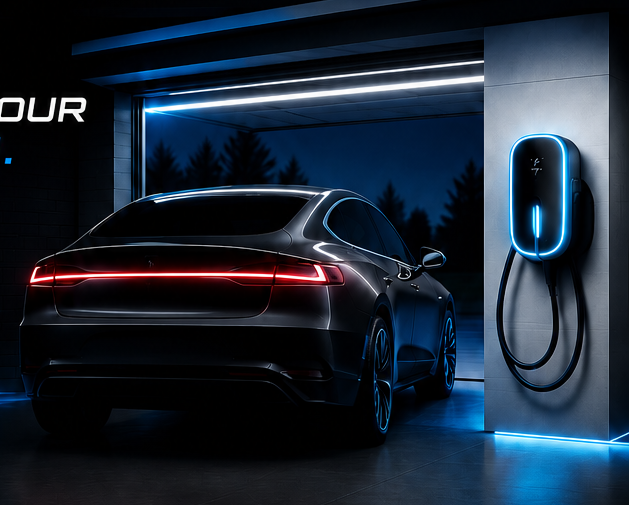
When household power returns after an outage, a home charger may reconnect normally, remain offline or display a fault. The safest response is not to open the equipment or repeatedly cycle breakers. First confirm that the outage has ended, observe the installation from a safe distance and use the manufacturer’s documented restart process.
Wait for stable household power
If lights are still flickering, partial power remains, utility crews are working nearby or severe weather is active, delay charging. Do not troubleshoot energized outdoor equipment during a storm or enter a wet area to reach a charger. Tesla’s troubleshooting guidance specifically warns against troubleshooting during a power outage or extreme weather.
Make a visual check without removing covers
- Look for a normal status light or a documented fault pattern.
- Check for visible water intrusion, impact damage or a loose enclosure.
- Notice burning odor, smoke, unusual heat or discoloration.
- Confirm the connector and cable were not damaged while power was out.
- Keep the vehicle unplugged if any condition appears unsafe.
Do not remove a cover, touch internal wiring or defeat a protective device. If there is smoke, arcing or fire risk, move away and contact emergency or utility help as appropriate.
Use the exact manufacturer instructions
Find the charger model and current support page. A documented power-cycle or app check may be appropriate for one product and wrong for another. Record the indicator color and blink pattern before changing anything. If the station is connected, note whether the app shows it online, updating or faulted.
Separate a charger fault from a vehicle issue
Check the vehicle display and charging settings. If another compatible station is available, the vehicle manufacturer may describe how to compare behavior safely. Do not use an unapproved adapter, extension cord or improvised connection as a test. Charging is limited by the circuit, equipment and vehicle, so one normal session elsewhere does not prove the home circuit is healthy.
Know when the electrical installation needs attention
Repeated breaker operation, recurring ground-fault indications, abnormal heat, damaged wiring or a charger that will not recover under its documented procedure calls for qualified evaluation. Share whether other household circuits were affected and whether electrical work, utility restoration or a surge event preceded the problem.
Build a useful service note
Record the outage time, restoration time, charger model, vehicle, indicator pattern, app message and steps taken from the manufacturer’s instructions. Photos of the exterior display can help. Do not include passwords or remove covers for a photo.
FAQ
Should I reset the breaker immediately?
Not automatically. Follow the charger manufacturer’s instructions and stop if the breaker trips again or the installation shows damage. Repeated resets can hide a condition that needs evaluation.
Can a power outage erase charger settings?
Behavior varies by product. Check the current app and manufacturer documentation for network, access-control and charging-schedule status.
Is a surge protector inside the charger?
Do not assume a feature that is not documented for the exact model. Ask the manufacturer and a qualified electrician about the installed system.
What requires immediate professional help?
Smoke, arcing, burning odor, visible damage, water intrusion, unusual heat or repeated protective-device operation should end the charging attempt.
SOURCES CHECKED OCTOBER 5, 2026
Tesla: Wall Connector Troubleshooting · ENERGY STAR: EV Chargers · U.S. Department of Energy: Home Charging
PLAN A SAFER HOME-CHARGING SETUP
Talk through the vehicle, parking position and electrical service before equipment is selected.
EV Garage Install can review the installation scope and prepare a practical quote for a code-compliant home charging circuit.