


USED EV • HOME CHARGING PLANNING
HOME CHARGING FOR A USED EV:
VERIFY BEFORE YOU BUY
A used EV may arrive without its original charging kit or with incomplete specifications. Confirm the exact vehicle and its AC charging limits before selecting home equipment.
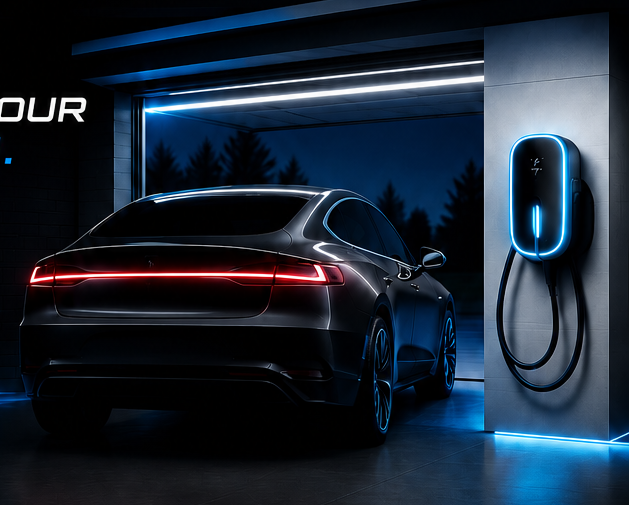
Buying a used electric vehicle changes the order of home-charging planning. Before choosing a wall unit, identify the exact vehicle, charging inlet, maximum AC charging rate, and any adapters that actually came with the car. Similar model names and model years can support different equipment.
Start with the exact vehicle configuration
Record the model year, trim, battery variant if known, and vehicle identification number for the dealer or manufacturer support team. The visible inlet helps, but it is not the entire answer: the vehicle’s onboard charger determines how much AC power it can accept.
Use the owner’s manual or manufacturer support information for that exact vehicle. Marketplace listings, old forum posts, and assumptions based on a newer model year are not reliable specifications.
Ask what transfers with the car.
Confirm whether a portable charging cord, adapter, wall unit, app account, and charging-network credentials are included. Treat an adapter with an unreadable label or unknown origin as something to identify before use.
Separate connector fit from charging capability
A plug or adapter that physically connects does not by itself confirm supported charging power or safe use. Check the vehicle and equipment manufacturers’ published compatibility information. If an adapter is required, verify its specific rating and permitted use.
For home AC charging, compare the vehicle’s acceptance limit with the charger’s configurable output and the electrical capacity available at the property. Installing a larger unit does not make a vehicle charge above its own limit.
Plan around daily energy, not a headline speed
Estimate typical miles driven, time parked at home, and the desired overnight recovery. The U.S. Department of Energy describes Level 1 and Level 2 charging as different home options; the practical choice depends on the vehicle and household routine.
An electrical assessment should cover the service, panel, proposed circuit, cable path, parking position, and any simultaneous large loads. Do not select a breaker or conductor size from the charger’s marketing maximum.
Check the used equipment separately
If the sale includes a wall charger, record its manufacturer, model, serial number, connector, and visible condition. Confirm whether ownership can be transferred and whether the maker still supports it. Do not assume an installed unit at the seller’s home can simply be relocated without assessment.
For a new installation, review EV Garage Install’s home charging services and installation process. Send clear photos of the proposed parking and equipment areas without removing electrical covers.
Used EV home charging questions
Do I need the fastest charger available?
Not necessarily. Match the vehicle’s AC limit, daily energy need, available charging window, and property capacity.
Can I rely on an adapter included by the seller?
Identify the manufacturer and exact model, then verify approved uses and ratings through official documentation before connecting it.
What if the original portable cord is missing?
That does not prevent planning a permanent home installation. It does mean you should choose replacement equipment based on verified vehicle requirements.
Should I test an unknown charger on the new car?
Do not use damaged, unlabeled, or unverified equipment. Have uncertain equipment identified before use.
PRIMARY SOURCES CHECKED OCTOBER 6, 2026
U.S. DOE home charging guidance · U.S. DOE charging equipment overview · ENERGY STAR electric vehicle chargers
PLAN THE COMPLETE INSTALLATION
Match the vehicle, equipment and electrical system.
Send your address, vehicle details, charger model, and safely taken photos of the proposed location and accessible equipment labels. EV Garage Install will discuss the scope and next assessment step.