

HOME ENERGY • EV CHARGING PLANNING
Solar plus EV charging.
Coordinate the complete system.
Solar, batteries, vehicle charging and utility rules should be planned as one electrical system—not as unrelated products.
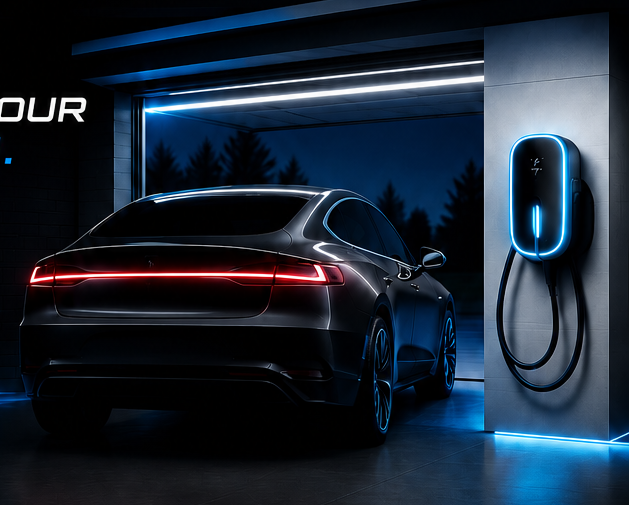
Solar panels and home EV charging can work together. However, installing both does not guarantee charging from sunshine alone. It also does not guarantee charging during an outage. The result depends on the design, solar output, home loads, parking hours, storage and utility rules.
Define what “charge from solar” means to you
One homeowner may want the vehicle to charge mainly during midday production. Another may want to offset annual household electricity use. A third may want power for selected loads during outages. Each goal needs its own plan for controls, storage and daily use.
Write down the vehicle’s normal energy use, when it is parked at home and the minimum charge needed for the next trip. Then document the home’s solar size, inverter, battery equipment and any existing energy-management system.
Separate energy accounting from real-time power flow.
Solar production can offset overnight charging across a billing period. However, that differs from sending midday solar power directly to the vehicle.
Coordinate charging time with solar production
Vehicle and charger schedules can help shift charging into selected hours, subject to compatibility and configuration. Midday charging may better overlap solar production when the vehicle is home. Overnight charging may better fit the driving routine or utility rate. The right schedule depends on the actual system and tariff.
Use the home charging schedule guide to decide whether the vehicle, charging equipment or another control should manage the start time. Avoid competing schedules in multiple apps.
Include the battery and outage goal
Standard grid-connected solar normally does not guarantee household power during an outage. The battery, isolation equipment and setup determine backup capability. EV charging uses substantial power. Therefore, the backup plan must state whether it supports, limits or excludes charging during an outage.
Do not connect a vehicle or portable power source to home wiring through an improvised cord. Bidirectional operation requires compatible equipment and a professionally designed system that safely isolates the home when required.
Check capacity in both directions
The installer should assess the service and panels first. Next, the review covers the solar connection, battery, charger circuit and other large loads. Adding solar does not automatically create unlimited service capacity for a charger. Likewise, a charger’s maximum rating does not establish the output the home or vehicle can use.
If capacity is constrained, an approved lower output or load-management design may be considered. See the EV charger load-management guide for planning questions.
Confirm utility and equipment requirements
Utility rates, export terms, interconnection rules and available programs vary. Ask the solar provider, charging-equipment manufacturer and utility for current information tied to the property. Do not assume that equipment eligibility, a promotional rate or a grid-services program applies at a particular address.
The U.S. Department of Energy advises households considering solar to account for planned load changes, including a future electric vehicle. That is especially useful when solar and charging projects are designed at different times.
Solar panels and home EV charging questions
Will solar charge my EV during an outage?
Not automatically. Backup operation depends on compatible storage, controls, isolation and the commissioned design.
Should I charge only during the day?
It depends on vehicle availability, solar production, household loads and the utility rate. Compare the goals before setting schedules.
Does solar eliminate the need for a capacity assessment?
No. The complete electrical system and proposed charging load still require assessment.
Can the charger follow excess solar production?
Some coordinated systems may support that function. Confirm compatibility and current manufacturer features for the exact equipment.
What should I send for an estimate?
Start with the vehicle and charger models, plus normal parking hours. Then add safe photos of accessible labels. Also include the solar, inverter and battery documents.
Read EV Garage Install’s installation services and project process before coordinating the trades.
PRIMARY SOURCES CHECKED OCTOBER 2, 2026
U.S. Department of Energy — Homeowner’s Guide to Solar · U.S. Department of Energy — Going Solar Guide · U.S. Department of Energy — Managed and Bidirectional Charging
LET’S PLAN YOUR INSTALLATION
Your garage. Your vehicle. A clear plan.
Send your address and vehicle details. Also send safe photos of the parking area and accessible equipment labels. Leave electrical covers in place.